

Meet Rick
 In the summer of 2010, Rick walked through the doors of Pacific House frightened, alone, and not knowing what to expect. He did know he had goals he was determined to achieve – most of all to finally live independently and have his own home. Rick was determined to take advantage of anything the Shelter had to offer to help make this happen.
Within just a few short weeks, after years of drug dependency and living on the streets, and years filled with loneliness, pain and frustration, Rick was well on his way to self-sufficiency thanks to his determination, the stability provided him by having a reliable source of food and shelter, and the support of a dedicated team of case workers and counselors.
Rick went on to complete the SFH recovery program and then both the SFH life skills, and workforce preparation programs. Today he has been drug and alcohol free for over three years and is a valued employee at a local restaurant where he has been steadily employed for well over a year.
For Rick, most important of all, today he is living independently in his own home.
After leaving Pacific House Rick was determined to give back, “because I was and am so grateful for everything they had done for me; and I knew that being part of the Pacific House family was where I needed to be.”
Not only does he currently volunteer by working alongside our staff helping to serve meals, Rick also works hands-on with clients through the SFH Outreach Program. “I spend time talking to people who are homeless about the programs available to them, which can help them get a place of their own … just as I was able to.”
Says Rick: “People often ask me why I still come to Pacific House; why I want to hang around a homeless shelter. I look at them, smile and simply say ‘the place saved me – I want to help save people like me’.”
Meet Maria
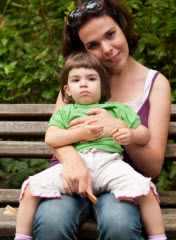 Abandoned several times as a child, then beaten repeatedly and abandoned by her husband as an adult, Maria arrived at SFH with her 4 year old daughter Suzie in tow desperately needing and wanting help – but understandably slow to open up, trust, and accept assistance.
After attending counseling sessions inconsistently for several weeks – and “disappearing” for extended periods on a couple of occasions (during which Maria and Suzie were periodically homeless) -- Maria gradually began to form a strong relationship with her case worker. With this relationship came the foundation of trust so necessary for healing and growth.
Through the SFH Health Care Program both Maria and her now 5 year daughter Suzie received some much needed and long overdue medical care. With the help of SFH staff, Suzie was enrolled in a pre-school program where her attendance was steady and her participation was strong. Maria received counseling, help with her resume, and training in job search and interviewing.
Today Suzie is a healthy 6 year-old. She is thriving in school where her teachers describe her as being “so bright” and talk about how she seems to “always be smiling.”
Maria and Suzie still face a difficult and uncertain future. As a single, low-income mom, Maria has struggled to find work and, when she is working, has struggled to balance the demands of her job with the needs of her daughter.
The focus of the team at SFH is currently to help Maria find steadier employment, and with the help of her caseworker, Maria has recently begun studying for her GED.
Meet Aaron
 Aaron speaks quietly and confidently about his life. Though he certainly has regrets, he is not ashamed of his past – he accepts it and understands he would not be who he is today without it.
Aaron knows that Pacific House, with its emergency shelter and recovery program, has been a constant source of hope and support through his years of struggle – years that have been hard, but have left him a better man.
A Stamford native, Aaron first started using drugs at 13 and eventually drifted into life on the streets. Now 42, he has been drug-free for five years – but many of the years in between were spent either incarcerated or in and out of shelters.
“The people from Pacific House were always there for me with an open door.” After going through the recovery program and staying drug-free for several years, Aaron applied for and was accepted into the SFH Supported Housing Program.
Aaron recently completed an environmental training program and obtained a license for asbestos removal. Now he is working on getting his GED degree.
In the future, he says he might like to work in social services: “I want to do something where I relate to people, where I use my experience to help them, to help them not make the same mistakes I made.”
“I can show them how the people at the Shelter did not give up on me and how they won’t give up on them.”
Aaron believes that “sooner or later a door will open” and he will find work where he can make a significant contribution.